
(KTSG) – Vietnam is in the process of amending the Land Law and related laws. The value of land and adequate compensation are among the issues of greatest concern.
The market price of land at a given time, like any commodity, is determined by supply and demand. If demand is high but supply is low, prices are high and vice versa. Land prices often fluctuate strongly due to the interaction between supply and demand depending on expectations of future use value. However, the value of land is basically formed from land rent. More specifically, the real or stable value of a piece of land is formed from the permanently discounted rental cash flow.
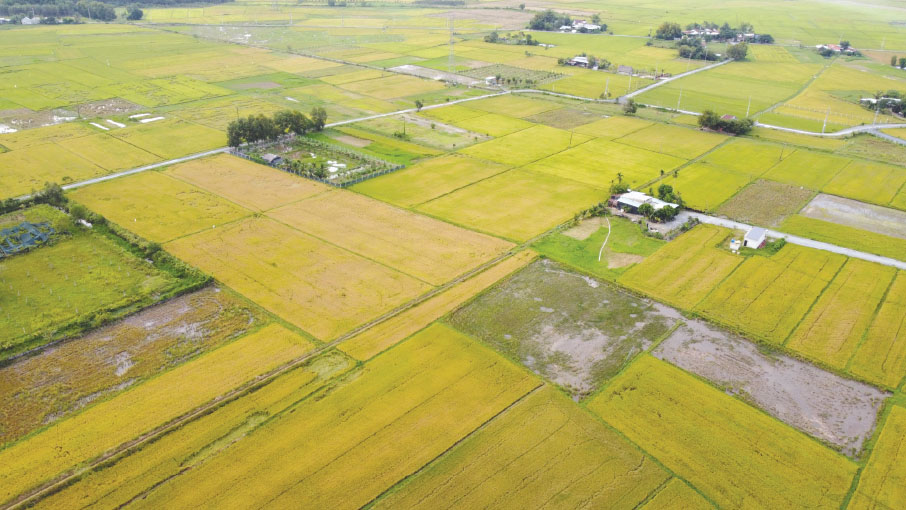
The current rental price of agricultural land on the outskirts of the city depends on the productivity or profitability of agricultural production. However, its future rent will depend on its future use. Land value is calculated through current rent, only if the purpose of use is not changed forever. Without any restrictions, land will naturally be used for the most profitable purposes. Therefore, the land is being used for agricultural purposes, but its value is made up of its potential for future use, not its agricultural value.
The value of a piece of land depends on the rights that come with it. The more complete the rights, the higher the value of this land. However, determining land ownership is very complicated.
Conceptually, property rights grant the owner the right to use and benefit from the property. The challenge is determining property rights. Theoretically, if you have full rights over an asset, you can do whatever you want, even destroy that asset. However, due to the complexity of interrelationships in our world, one person’s actions in most cases usually cause some positive or negative impact on others. Property rights are therefore often incomplete and dependent on the institutional environment as well as local norms and customs. Certain sets of rights are often restricted in different jurisdictions.
Restrictions vary widely across countries or regimes, but the higher an asset’s potential externalities, the stricter the restrictions on it. Among them, land is probably the most complex and its use creates the most externalities. Therefore, the state is most involved in land-related issues, especially land recovery.
In principle, land can be confiscated through many methods, from confiscation without compensation to free agreement. However, land acquisition with state participation is in most cases actually a coercive and asymmetric process. This is especially true in developing countries where institutions are immature. In the context of increasing pressure to attract investment capital, the state often implements coercive measures to relocate residents and clear land. Owners often say it’s unfair. The main cause of resistance from people whose land is recovered is that compensation is often considered inadequate or unfair.
Satisfactory compensation level
The main issue is what level of compensation is adequate, or is there a level of compensation that both the land reclaimer and the land owner are satisfied with? This is truly a controversial issue in human society.
For example, in the United States, the Supreme Court has clarified that “Just Compensation” under the Fifth Amendment is measured by the market value of the property at the time of recovery. However, it is not easy to get a reasonable price in the market, even impossible in many cases.
There are often differences in the perception of land value between the recovering party and the person whose land is recovered. The state often believes that compensation should be based on the original use of the acquired land. This viewpoint is clearly expressed in the land regulations of China and Vietnam. For example, according to China’s land regulations, the total amount of resettlement and land compensation cannot be greater than 30 times the obtained land yield, i.e. the average yield per hectare in the previous three years. there. The basic assumption of this perspective is that farmers will commit their lives to farming forever. This is not reasonable because the land will be used for the highest profit and the value of land in this case is often driven by factors other than its farming potential.
On the contrary, landowners argued that compensation should be based on the market value of the transactions they observed. The problem is that it is difficult to know the observed market price. They are often well above fair value due to infrastructure investments and speculative factors. According to rational expectations theory, land prices depend partly on what people expect will happen. This is very true for the real estate market, especially in developing countries. Infrastructure investment helps increase land value. This investment is often incurred partly in the price of the land before it is built. As soon as an infrastructure project is announced, real estate prices in the area begin to increase because people expect future rental prices or income from the land to increase.
Furthermore, real estate market supply in developing countries is often limited while demand is often high and speculation is quite common. This causes land prices to often be much higher than the value based on the discounted cash flow model. In other words, the market price of land in developing countries is in many cases higher than its real value. These two problems cause landowners’ expectations to become too high and they demand compensation based on those unreasonably high expectations.
Even if compensation is based on market prices, the question will be which price, the price at the time of project or development plan announcement or when compensation is actually paid. For projects lasting years, even decades, prices often fluctuate a lot. Furthermore, how to share or distribute the added value during land development is very difficult. It is really difficult to find adequate compensation due to the difference between three numbers: land price based on current use, fair market price and speculative market price. One of the results of this problem is that all three main players (citizens, businesses and public officials) are seen as greedy.
In summary, the value of land, the market price of land and the level of adequate compensation are complex issues and it is difficult to obtain a level of compensation that satisfies all parties in land recovery. Therefore, policies need to be realistic and consider the pros and cons for society as a whole, not perfectionism.